- Colic is when a baby cries a lot but there’s no obvious cause.
- While crying, the baby is hard to soothe, clenches their fists, goes red in the face, brings their knees up to their tummy or arches their back, and their tummy rumbles or they’re very windy.
- It’s not known exactly what causes colic; it may be because babies find it harder to digest food when they’re young.
- If your baby swallows air while bottle feeding, they may feel uncomfortable and cry.
- Tips: sit or hold your baby upright during feeding to stop them swallowing air; keep the bottle horizontal, just slightly tipped, so the milk flows steadily; and wind your baby after feeds.
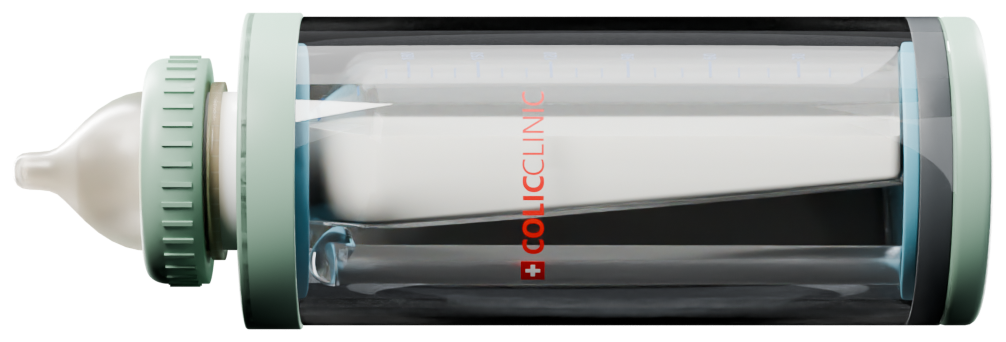
Baby bottle with a self-levelling rotating reservoir
Milk, not air
A baby bottle whose inner reservoir turns with gravity and brings the milk to the nipple at any angle. For calmer feeding, from birth to age two.
NHSUK National Health ServiceNational Health Service · nhs.uk
AAPAmerican Academy of PediatricsAmerican Academy of Pediatrics · healthychildren.org
Swallowed air makes babies unsettled
If your baby swallows air while bottle feeding, they may feel uncomfortable and cry. Keep the bottle in a horizontal position (just slightly tipped). This will allow the milk to flow steadily and help prevent your baby from taking in air.NHS (UK)
If your infant is using a bottle, you can consider switching to an anti-colic bottle to reduce excess swallowed air.American Academy of Pediatrics
Same angle, two bottles
When the bottle tilts, where does the milk go?
Ordinary bottle same body and nipple, no reservoir, 30% full
Nipple full of milk
COLICCLINIC true section of the 3D model, 30% full
Nipple full of milk
Nipple angle to the horizontal۲۴°pointing down
How it works
The body turns in your hand; the reservoir doesn’t
Inside the clear body, the reservoir turns freely on two plastic bearings. A counterweight underneath always keeps it facing down. The reservoir floor slopes in one straight line to the outlet, and a channel as wide as the outlet carries the milk right into the nipple, so milk never gets stuck and air is never trapped. However the baby moves and however the parent holds it, the reservoir finds its place.
Body rotation in the hand۰°
Reservoir offset from balance۰°
Gravity onlyNo springsNo batteries
Design · no tubes, springs or motors
Seven parts, all removable and washable
International patent filing
PCTWIPO
An internationally filed invention
The self-levelling rotating-reservoir mechanism is the subject of an international patent application under the Patent Cooperation Treaty (PCT), published by the World Intellectual Property Organization (WIPO).
- International application number
- PCT/IB2025/058317
- International publication number
- WO 2026/041978
InventorsBabak Sheyda KhangheshlaghiBehjat Sadat Mohammadi
View the record on WIPO PATENTSCOPE ↗
NHSUK National Health ServiceNational Health Service · nhs.uk
AAPAmerican Academy of PediatricsAmerican Academy of Pediatrics · healthychildren.org
BMCBMC Pediatrics (journal)BMC Pediatrics · Springer Nature
F1000F1000Research (journal)F1000Research
What science says
What medical sources say about air, wind and colic
- Colic affects about one in five infants.
- All humans produce gas, even the littlest ones; a build-up of gas causes discomfort, but it is not dangerous.
- Avoid feeding your baby when they’re overly hungry; they may swallow more air if they are frantically feeding.
- If your infant is using a bottle, you can consider switching to an anti-colic bottle to reduce excess swallowed air.
- Burp your infant before, halfway through and after a feed; keeping them upright after feeding can help their stomach empty.
- Researchers compared the sucking pattern of healthy infants on two kinds of teat: with an anti-colic (vented) system and without.
- 96 infants were assessed, and data from 73 were fully analysed.
- Apart from the number of sucking pauses per minute, no differences were found between the groups.
- The authors concluded that the anti-colic teats gave a more coordinated drinking pattern than the non-vented teats.
- Excessive infant crying has several causes and is related to feeding difficulties and disorders.
- Swallowed air has been suggested as a contributing factor.
- Less than 5% of infants who cry excessively have an underlying physical disease.
- Reassuring parents is the cornerstone of managing infantile colic.